SaaS Companies and Free Trial Sign Up: The 2026 Conversion Framework
SaaS companies free trial sign up in 2026: the 4-pillar conversion framework, why most trials leak users, and how AI-sourced signups behave differently.

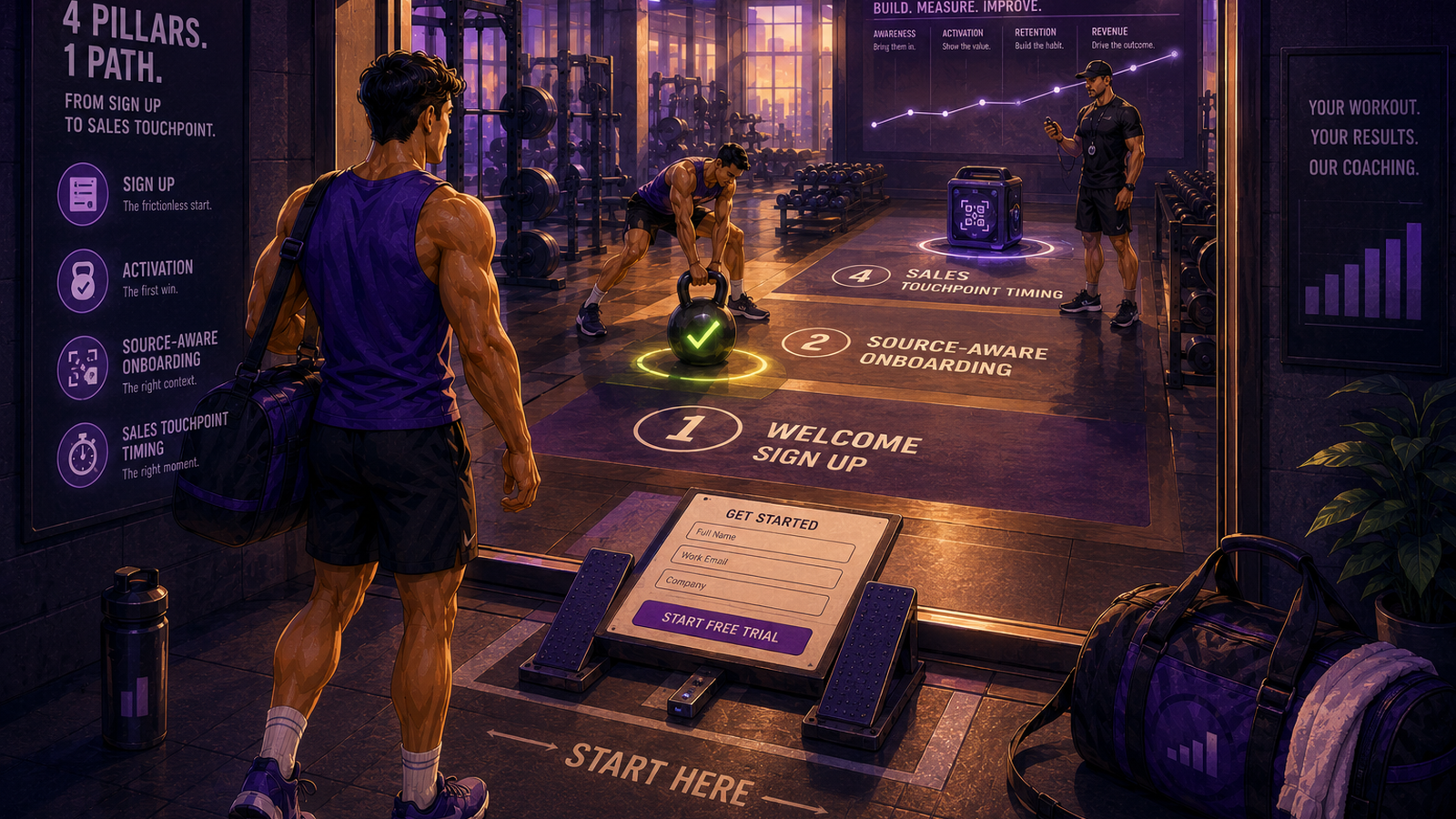
Most SaaS companies treat free trial sign up as a single conversion event. In 2026 it is a 4-pillar framework, and the SaaS teams that still optimize for the form fill alone are leaking 30 to 50 percent of buying intent.
This piece is the framework we run with Veloice clients to fix the leak before AI-sourced signups become the dominant entry path.
What does free trial sign up actually mean for SaaS in 2026?
Free trial sign up is the structured conversion path that takes a buyer from initial intent to activated product usage, measured at the product-qualified-lead (PQL) layer, not just the form-submit layer. The 2026 update adds AI source attribution because trials that originate from ChatGPT or Perplexity behave differently downstream.
Per Nielsen Insights on signup conversion benchmarks, SaaS signup conversion rates split materially by source: AI-sourced signups convert to paid 25 to 40 percent more often than cold form fills of the same firmographic profile.
The 4 pillars of high-converting SaaS free trial sign up
Each pillar maps to a specific failure mode we see when companies bring us in to audit a stalling trial flow.
Pillar 1: Form friction that does not flatter the funnel
The form should capture only what is needed to provision the trial. Email plus password plus company name is the standard. Anything more is a leak.
Source attribution can be captured at the form layer as a dropdown without adding meaningful friction. Skip it and the entire downstream PQL model is blind to AI engine sources.
Pillar 2: Activation milestone defined explicitly
The trial must have a named activation milestone. "User uploaded data" or "user invited a teammate" or "user ran first report". Without a named milestone, the team optimizes for the wrong stage.
Per TechCrunch SaaS on free trial design trends, the SaaS teams that named their activation milestone in 2024 saw 30 to 50 percent faster trial-to-paid conversion across 2025.
Pillar 3: Source-aware onboarding
Onboarding emails should reference the buyer's likely research path. A ChatGPT-sourced signup probably saw a vendor comparison; the onboarding should open with "you compared us alongside [common alternatives]" instead of "welcome to our product".
Source-aware onboarding raises activation rates because it speaks the buyer's research language, not the product team's positioning.
Pillar 4: Sales-touchpoint timing tied to behavior
PLG-led SaaS still benefits from sales touchpoints; the question is when. The right rule is to trigger sales contact when the user hits the activation milestone, not on day 1 or day 7 by calendar.
AI-sourced signups tend to hit activation faster than cold signups because they arrived with buying intent. Triggering sales by behavior, not by calendar, captures that intent before it cools.
SaaS free trial sign up in 2026 is a four-pillar conversion path, not a single form event. Teams optimizing only the form leak the channel that increasingly opens B2B buying journeys.
How to apply the framework without rebuilding the product
You do not need to rebuild the product to apply this. The form pillar is a 1-week change. The activation milestone pillar is a 2-week change. Onboarding source-awareness is a 3 to 4 week email-sequence rewrite. Behavioral sales triggering needs CRM hygiene work.
Total: 6 to 8 weeks to apply all four pillars at mid-market scale. If you want a baseline read on how your current trial flow performs against the framework, request a free AI Visibility Snapshot and we will run the audit. See who Veloice helps for fit profiles.
FAQ
What is the average free trial conversion rate for B2B SaaS in 2026?
Healthy B2B SaaS sees 15 to 30 percent trial-to-paid conversion. AI-sourced trials convert 25 to 40 percent above the average for the same firmographic profile.
Should B2B SaaS gate the trial behind a credit card?
For PLG-led models, no. The credit-card gate cuts top-of-funnel signups by 40 to 60 percent without proportional improvement in close rate.
How long should a SaaS free trial be in 2026?
14 days is the modern norm for most B2B SaaS. Longer trials reduce urgency; shorter trials cut activation time for complex products. Match length to time-to-activation, not to industry convention.
How does AI search visibility affect free trial sign up volume?
Directly. AI-sourced signups grow faster than any other channel for most mid-market B2B SaaS, and they convert at materially higher rates. Without source tagging, you cannot see the lift in dashboards.
Should B2B SaaS use a freemium model instead of a free trial?
It depends on activation complexity. Freemium works when the product's "aha" moment lands in under 10 minutes. Trials work better for products that require 30+ minutes of setup before value lands.
What is the single biggest signup conversion mistake B2B SaaS makes?
Adding too many required fields to the signup form. Each additional required field drops conversion 4 to 7 percent. Capture the minimum, enrich post-submit.
How do AI-sourced trials behave differently in onboarding?
They hit activation milestones 30 to 50 percent faster on average because they arrived with vendor research already complete. Onboarding sequences that assume a cold user under-serve this cohort.
Written by
Saksham Solanki
Founder, Veloice · Veloice
Building Veloice, an AEO and GEO agency for B2B teams whose buyers research vendors in ChatGPT, Perplexity, Claude, and Gemini before contacting sales.
Connect on LinkedIn →