Digital Marketing Agency Lead Generation: The 2026 Operator's Pillar Guide
Digital marketing agency lead generation in 2026: the full operating model, AI search shift, channel mix math, CRM attribution, and the playbook we run.

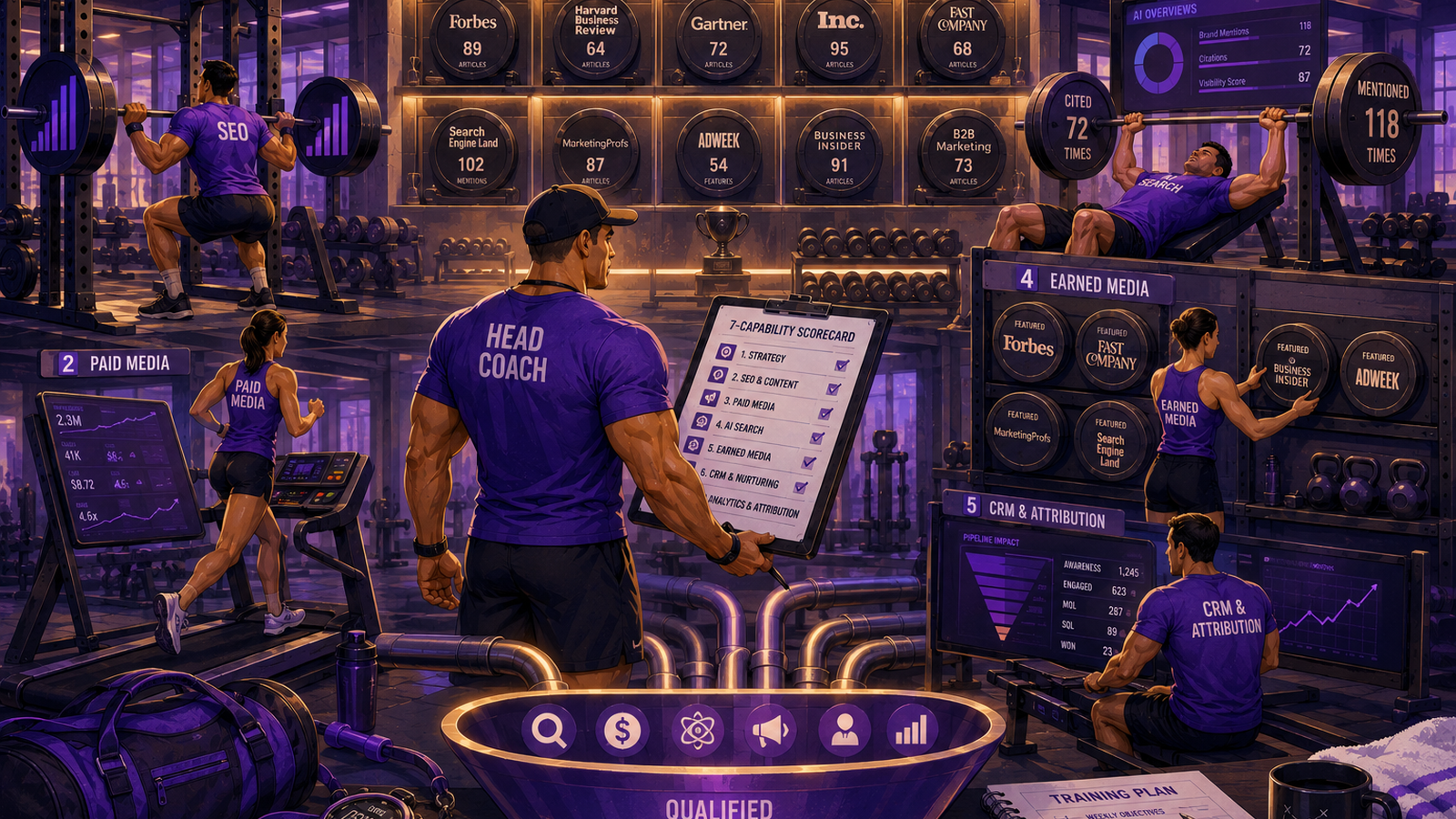
A digital marketing agency that cannot show citation share movement inside 90 days is selling 2020 deliverables. The category split cleanly in 2024 and most B2B teams hired the wrong half.
This is the operator's pillar guide. The full operating model, the channel mix math, the CRM attribution layer most teams skip, and the playbook we run on every Veloice engagement.
What does a digital marketing agency lead generation engagement actually deliver in 2026?
It delivers qualified inbound pipeline tagged at the CRM opportunity layer, with source attribution including AI engine origin, measured against closed-won revenue at quarterly review. The classic version stopped at MQL volume.
The modern version cannot. According to Bain insights on B2B growth and channel mix, the agencies that rebuilt their delivery around AI search visibility in 2024 are now outpacing peers on retention and pipeline contribution by 30 to 50 percent.
How is digital marketing agency lead generation different from generic agency work?
A lead-generation-specialist agency owns the pipeline-contribution conversation. A generic digital agency owns the traffic conversation. Both look the same on a Trello board and produce wildly different revenue outcomes.
The depth shows up in the first call. A lead-gen specialist talks about CAC payback, MQL-to-SQL conversion, AI engine source attribution, and quarterly closed-won review. A generic agency talks about sessions, bounce rate, and time on page.
What 7 capabilities matter most in a digital marketing agency for B2B lead generation?
We use this checklist when B2B teams ask us to score competing agencies. Skip any one and the engagement starts at a structural disadvantage.
- AI search visibility tracking. Citation panel across ChatGPT, Perplexity, Claude, and Gemini, weekly cadence.
- Entity audit and rebuild. Cross-property language alignment as week-one deliverable.
- Answer-first content production. Pages open with citable answers, with FAQ schema.
- Earned media pitching. Trade publications, Reddit communities, podcast circuits.
- CRM source tagging instrumentation. Required on day one, not deferred.
- Pipeline attribution review cadence. Quarterly closed-won review tied to channel.
- B2B vertical depth. ICP language, category positioning, sales cycle math.
If an agency fails three or more, they are running last cycle's playbook with new naming.
What does a real engagement look like at $10M ARR?
The first month is audit and entity work. The agency runs a 60 to 200 query citation panel against four AI engines, audits the entity description across 8 to 12 owned and third-party properties, and surfaces the gaps generic agencies miss.
By end of month one, you have a baseline citation share number and a written entity rebuild plan. This is the foundation that compounds.
Months two and three are source-citation work and content rebuilds. The agency pitches two contributed pieces to trade publications, refreshes G2 / Capterra profiles, and rewrites the top 10 product and category pages in answer-first format with FAQ schema. Citation share moves visibly in this window.
Months four and five are amplification and pipeline. The agency runs a Reddit and community presence layer, instruments inbound forms with explicit AI-engine source tagging, and starts the back-channel attribution work with sales. Month four is when AI-sourced inbound starts showing in CRM as a distinct lead source.
Month six is review. The agency presents citation share movement, pipeline contribution data, and the 12-month plan. If the data is not there, renegotiate or replace.
Read the Veloice methodology for how each phase connects.
How much does a digital marketing agency for lead generation cost in 2026?
Pricing clusters into three tiers, and the gap between them is wider than it looks.
| Tier | Monthly cost | Best for | Capabilities included |
|---|---|---|---|
| Entry | $3K–$8K | $1M–$5M ARR | Single specialty, one channel, retained |
| Mid | $8K–$25K | $5M–$50M ARR | Entity, source, content, AI search |
| Enterprise | $25K–$100K+ | $50M+ ARR | Multi-region, custom analytics, senior |
Cost is rarely the binding constraint. The constraint is whether the agency moves citation share, AI-sourced inbound volume, and closed-won revenue against the baseline.
How should B2B teams measure lead generation agency ROI in 2026?
Two layers: leading indicators and lagging indicators. The leading layer should move in 4 to 8 weeks; the lagging layer should move in months 3 to 6.
Leading indicators: citation share across the four major AI engines, ranked keyword positions in Google, earned media placements per quarter. Lagging indicators: AI-sourced inbound volume in CRM, opportunity-to-revenue conversion, closed-won revenue attributed to the agency's work.
We benchmark engagements against a 3-to-1 to 6-to-1 return on agency cost based on closed-won revenue tracked in CRM with source tagging.
What are the most common digital marketing agency lead generation mistakes B2B teams make in 2026?
The most common mistake is hiring an agency that treats AI search as a content channel. Volume of content does not move citation share. Quality of entity signals, depth of third-party proof, and structural answer density do.
The second mistake is single-channel optimization. Agencies that only run SEO miss Perplexity and Claude. Agencies that only run paid social miss Gemini citations.
Third, treating the engagement as a six-month campaign rather than a sustained program. Citation share decays if the underlying entity and source work is not maintained.
Fourth, no CRM hygiene around AI-sourced inbound. Without source tagging, the channel looks invisible in dashboards and budget conversations stall.
Fifth, hiring an agency that does not understand B2B finance. If the strategist cannot speak to CAC payback or NDR, they will optimize for traffic instead of revenue.
A real example: a B2B SaaS company at $14M ARR
A B2B SaaS company in the revenue-operations category came to us with healthy SEO traffic and a pipeline that had contracted 19 percent year over year. Their previous agency produced two blog posts per week and ran paid social. Pipeline was shrinking despite the activity.
We ran a 90-query AI citation audit. Their brand appeared in 9 percent of vendor-shortlist queries. Three competitors with smaller content footprints appeared in 55 to 70 percent of the same queries.
The reason was source citations. The competitors had heavy earned-media presence in two trade publications and a Reddit community. Our client had owned content only.
We rebuilt the entity description across the homepage, LinkedIn, Crunchbase, and three category directories. We pitched contributed pieces to two trade publications, seeded authoritative quotes in a Reddit RevOps thread, and refreshed the G2 profile. Owned-content work shifted from "publish more" to "rewrite top pages in answer-first format with FAQ schema."
In 90 days, citation share moved from 9 to 41 percent. Pipeline did not jump immediately. It moved in month four, when reps started reporting that prospect calls increasingly opened with "we saw you mentioned in." That is the loop a modern lead generation agency is supposed to enable.
The first quarter of any serious lead generation engagement is entity and source work. If your agency is shipping blog posts in week one, they skipped the foundation.
When should a B2B team hire a digital marketing agency for lead generation versus build in-house?
Hire an agency when you need specialist capability your internal team does not have, when the work is project-shaped, or when you cannot hire the senior operator the work requires.
Build in-house when the work is steady-state and predictable, when internal context compounds advantage, or when you have already grown to the headcount that justifies the salary.
The right model for most $5M to $50M ARR B2B is hybrid. An agency runs the AI search visibility specialty and earned-media pitching because those skill stacks are hard to hire for. An internal team runs product marketing, customer marketing, and senior strategy.
According to Forbes Business on AI disruption to B2B marketing, the budgets that grew in 2025 were the ones tied to CRM attribution, not traffic dashboards. Agencies reporting on traffic alone are losing renewals quietly.
For B2B teams below $5M ARR, an agency is usually right because the cost of a senior in-house hire exceeds the agency cost while delivering less specialty depth. See Veloice services for the engagement shapes we run at different ARR stages.
What does the future of digital marketing agency lead generation look like by 2027?
Per HBR on the new B2B buying journey, the agency category will continue to split between specialists who own pipeline attribution and generalists who own traffic dashboards. The pricing gap will widen.
The agencies that win 2027 will have native multi-engine citation tracking, dedicated earned-media motion, and tight CRM integration as standard capabilities, not premium add-ons.
If you want to see where your current agency sits in this transition and where the pipeline gap is hiding, request a free AI Visibility Snapshot. We run a 30 to 50 query panel across five AI engines and return the report. See who Veloice helps for the team profiles where this works best.
FAQ
How long does a digital marketing agency take to drive B2B pipeline?
Citation share moves in 4 to 8 weeks. Pipeline contribution shows in month 3 to 4. Closed-won revenue attributed to the agency typically lags by another quarter, so a fair budget horizon for the first complete revenue loop is 6 to 9 months.
What is the typical CAC payback an agency should target for B2B?
For mid-market B2B, 12 to 18 month CAC payback on agency-sourced opportunities is healthy. Anything past 24 months means the agency is optimizing for the wrong stage of the funnel.
Can a small B2B company afford a lead generation agency?
Yes. Entry-tier engagements at $3K to $5K per month give Series A teams senior strategy plus tactical execution at a fraction of the cost of an in-house hire. The trade-off is fewer hours per month, so prioritize ruthlessly.
How is a digital marketing agency for B2B SaaS different from one for B2B services?
A B2B SaaS-specialist agency optimizes for free trial conversion, product-led growth funnels, and seat-based pricing math. A B2B services-specialist agency optimizes for inbound demo conversion, longer discovery cycles, and retainer expansion. The skill stacks overlap on AI search and PR but diverge on funnel design.
Should a B2B team hire one full-service agency or multiple specialists?
For $5M to $50M ARR B2B, one full-service agency with multi-channel coverage usually wins on coordination cost. Above $50M ARR, multi-specialist mixes start to outperform because each layer needs deeper specialization than any single agency can provide.
What are the most common red flags in digital marketing agency proposals?
Generic case studies without named clients or specific metrics. Vague "we'll add AI search later" commitments. No mention of CRM source tagging in the scope. Pricing tied to deliverables rather than outcomes. Each of these signals that the agency is rebranding 2020 services for 2026 buyers.
How often should a B2B team review their marketing agency's performance?
Weekly for citation share movement and earned-media placements. Monthly for pipeline contribution and channel-mix recalibration. Quarterly for closed-won attribution and contract renewal decisions. Annual reviews are too slow for the 2026 buying journey to course-correct in time.
Can a digital marketing agency handle both inbound and outbound for B2B?
Most cannot at the same depth. The skill stacks diverge: inbound rewards entity work, content rebuilds, and earned media; outbound rewards sequencing technology, intent data, and SDR ops. The agencies that genuinely do both typically structure as two independent teams under one contract.
How is AI changing the digital marketing agency category beyond lead generation?
AI is also reshaping creative production, paid media bidding, and attribution modeling. The agencies that build native AI capability across all four functions, not just lead generation, are the ones likely to dominate the 2027 mid-market. The rebranded-SEO incumbents lose share fastest because the lead generation rebuild requires the most operator change.
Should B2B startups under $1M ARR hire a digital marketing agency at all?
Usually no. Below $1M ARR, founder-led marketing plus a single freelance specialist (content or PR) outperforms agency engagement at the same total cost. Agencies start to make sense once the founder cannot personally own the marketing function full-time.
What is the single biggest mistake B2B teams make when hiring a digital marketing agency?
Picking on price rather than operating cadence. A $5K-per-month agency that runs weekly citation reviews and monthly pipeline-attribution sessions beats a $15K-per-month agency that runs quarterly traffic decks. The operating cadence determines outcomes; the price tag does not.
How does a digital marketing agency for lead generation work with the sales team?
A serious agency establishes shared dashboards with sales, attends weekly pipeline reviews, and trains reps on how to log AI engine source during discovery calls. Agencies that operate in marketing-only silos see their work disappear in sales-side numbers and lose renewals.
What contract length is healthy for a B2B digital marketing agency engagement?
Six-month minimums are standard for citation share work to compound. Twelve-month contracts with quarterly break clauses give both parties accountability while preserving the buyer's exit if the work is not landing as promised.
How should B2B teams onboard a new digital marketing agency in the first 30 days?
Hand over CRM access, brand entity assets, and competitive context in week one. Schedule a weekly recurring review by end of week two. Expect the citation baseline audit and entity rebuild plan by end of month one. Anything slower signals the agency does not have the operating cadence to compound.
Written by
Saksham Solanki
Founder, Veloice · Veloice
Building Veloice, an AEO and GEO agency for B2B teams whose buyers research vendors in ChatGPT, Perplexity, Claude, and Gemini before contacting sales.
Connect on LinkedIn →