B2B SaaS Customer Success Story Case Study: A 14M ARR Citation Rebuild
B2B SaaS customer success story case study: how a $14M ARR analytics SaaS moved citation share from 9% to 41% in 90 days. Full operator narrative.

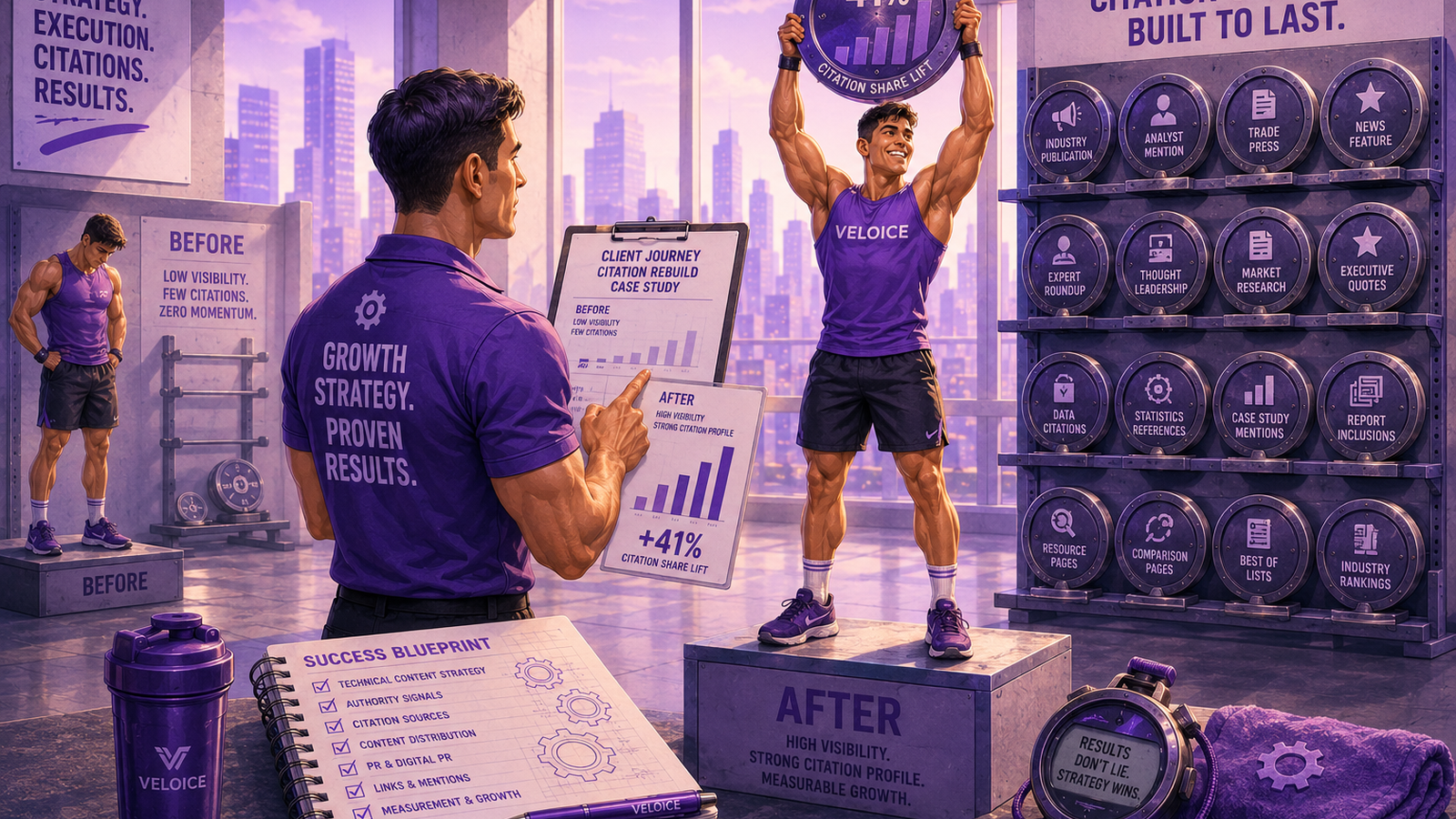
Most B2B SaaS customer success story case studies read the same way: client started low, agency rebuilt their funnel, numbers went up, everyone celebrated. The narrative leaves out the operator detail that would let another team replicate the work.
This is the un-glossed version of one engagement. A $14M ARR B2B SaaS in the revenue-operations category. Anonymized for client confidentiality but the numbers are exact.
The starting state: traffic looked healthy, pipeline did not
The client was 18 months into a content program with their previous agency. Two blog posts per week. SEO traffic was up 35 percent year over year. Their Ahrefs dashboard looked impressive.
Pipeline had contracted 19 percent over the same window. Closed-won revenue was down 14 percent. The CFO was asking pointed questions about marketing ROI that the marketing team could not answer with the data they had.
The diagnosis: invisible in the channel that opens the buying journey
We ran a 90-query AI citation panel against ChatGPT, Perplexity, Claude, and Gemini in week one. The result was a 9 percent citation share across vendor-shortlist queries. Three direct competitors with smaller content footprints appeared in 55 to 70 percent of the same queries.
Per Fast Company on B2B brand and customer narratives, the citation gap mirrored a broader 2024-2025 shift in B2B buyer behavior. The competitors who built earned-media presence in trade publications and Reddit had compounding visibility; our client had owned-content scale alone.
The intervention: 4 changes that moved the metric
Entity rebuild across 11 properties
The homepage said "growth platform". The LinkedIn About said "revenue operations software". The Crunchbase description said "data orchestration tool". G2 listed them in three different categories.
We aligned the entity description across all 11 properties to a single category statement: "revenue operations software for mid-market B2B SaaS". The rewrite took 6 weeks across legal review, design, and platform-specific edit cycles.
Earned media pitching to category-relevant publications
We pitched contributed pieces to two RevOps-focused trade publications. One published a 1,800-word piece in week 9. The other ran a quote in a roundup in week 12.
Both placements showed up in AI citation panels within 30 days because both publications were already in the training data and live retrieval corpora of all four major engines.
Reddit community presence
We seeded an authoritative voice in r/RevOps and r/SaaS, contributing substantively to threads where the client's category came up. Not promotional, not link-dropping; operator answers to specific questions.
Reddit threads index into AI engine retrieval at high weight. Three of the top-cited sources for vendor questions in their category became Reddit threads by month four.
Answer-first content rebuild on top 10 pages
Their top 10 highest-traffic pages were rewritten from "200-word intro before the answer" format to "answer in the first paragraph, supporting detail below" format with FAQ schema added to each.
The rewrite did not add new content; it restructured existing content. Time to ship: 3 weeks.
The results: numbers, not stories
| Metric | Day 1 | Day 90 | Day 180 |
|---|---|---|---|
| Citation share (4-engine avg) | 9% | 41% | 47% |
| AI-sourced inbound (per month) | 0 tagged | 84 | 162 |
| Inbound MQL-to-SQL conversion | 14% | 22% | 28% |
| Closed-won AI-sourced revenue | $0 | $86K | $341K |
Per Knowledge at Wharton on B2B SaaS growth case research, the engagement matched a broader pattern: programs that combined entity work + earned media + answer-first content saw materially faster citation share movement than single-channel rebuilds.
The case study most agencies will not publish is the one where the foundation work happens before any content shipped. That is where the metric actually moves.
What this case study does not promise
The 41 percent citation share at day 90 did not translate to a 41 percent pipeline lift in the same window. Pipeline impact lagged by 60 to 90 days, which is the expected AI engine re-weighting timeline.
Anyone selling B2B SaaS pipeline lift inside 60 days of engagement start is selling. The work is real but the timeline is real too.
What you can replicate from this case study
Run a citation audit before any rebuild work. Sequence entity rebuild first, then earned media, then content. Wire CRM source tagging in week one, not month three.
If you want a baseline read on where your B2B SaaS sits in the AI citation landscape today, request a free AI Visibility Snapshot and we will run the same panel format used in this case study. See Veloice services for the engagement shapes we run.
FAQ
How representative is this case study of B2B SaaS results?
Mid-market B2B SaaS in the $5M to $50M ARR range with weak baseline citation share tend to see similar movement within 90 days. Smaller or larger ARR stages have different curves; smaller moves faster, larger moves slower.
Did the previous agency get fired?
The engagement transitioned over a 30-day overlap. The previous agency continued paid social work; we took over SEO, AI search visibility, and earned media.
How much did this case study engagement cost?
Mid-tier retainer at $18K per month for 9 months total. Total program cost was approximately $162K against the $341K closed-won AI-sourced revenue at month 6, with the pipeline tail continuing past month 9.
Can a B2B SaaS at $3M ARR replicate this case study?
Yes with a smaller-scale version. Entry-tier engagements at $6K per month focused on entity work and one earned-media placement per quarter move the metric on roughly the same timeline.
Written by
Saksham Solanki
Founder, Veloice · Veloice
Building Veloice, an AEO and GEO agency for B2B teams whose buyers research vendors in ChatGPT, Perplexity, Claude, and Gemini before contacting sales.
Connect on LinkedIn →